
CLASSICAL
The recorded breakout direction agrees with the conventional bias of the detected pattern. Continue to check confirmation, target, invalidation, zones, and lifecycle; agreement does not guarantee follow-through.
Article
Learn how Pattern Horizon separates classical pattern bias from realized breakout, what CLASSICAL, OPPOSITE, and NEUTRAL alignment mean, and how zone or timeframe conflicts can change the integrated reading.
Technical context guide
A market pattern can have a textbook direction and still break the other way. Pattern Horizon preserves both facts. Classical bias describes the direction normally associated with the detected structure; Realized breakout records the direction price actually took when a valid breakout was observed; Alignment explains whether those directions agree. Zone and timeframe conflicts add another layer, which can turn the integrated reading into UNCLEAR even when the individual pattern fields remain valid.
Three fields, three questions
Classical bias asks: if this pattern resolves in its conventional textbook direction, which way would that be? A bullish cup-and-handle, for example, has a classical bullish orientation. Some Elliott structures carry a post-pattern bias based on the corrective structure being evaluated. This field describes the pattern model, not a guaranteed future move.
Realized breakout asks: when the configured breakout evidence was recorded, which direction did price actually take? Before that event, the value can remain NEUTRAL. After a valid break, it can become BULLISH or BEARISH independently of the classical expectation.
Alignment compares the first two answers. CLASSICAL means the realized breakout agrees with the classical bias. OPPOSITE means the realized breakout occurred against it. NEUTRAL generally means there is not yet a realized direction to compare or the relationship is unresolved.
Keeping the fields separate prevents hindsight. The platform does not rewrite the original pattern bias after price chooses another path; it records what the structure suggested and what the market subsequently did.
Alignment dictionary
Alignment is a comparison field. It is not a recommendation, confidence percentage, or quality grade.
The recorded breakout direction agrees with the conventional bias of the detected pattern. Continue to check confirmation, target, invalidation, zones, and lifecycle; agreement does not guarantee follow-through.
The recorded breakout direction is opposite to the pattern's classical bias. The realized event takes priority when describing what happened, but it still does not guarantee a target or create personalized trade advice.
A decisive realized breakout is not available for comparison, or the relationship has not been resolved. Read the current Status and confirmation boundary instead of forcing either directional interpretation.
An opposite breakout can complete
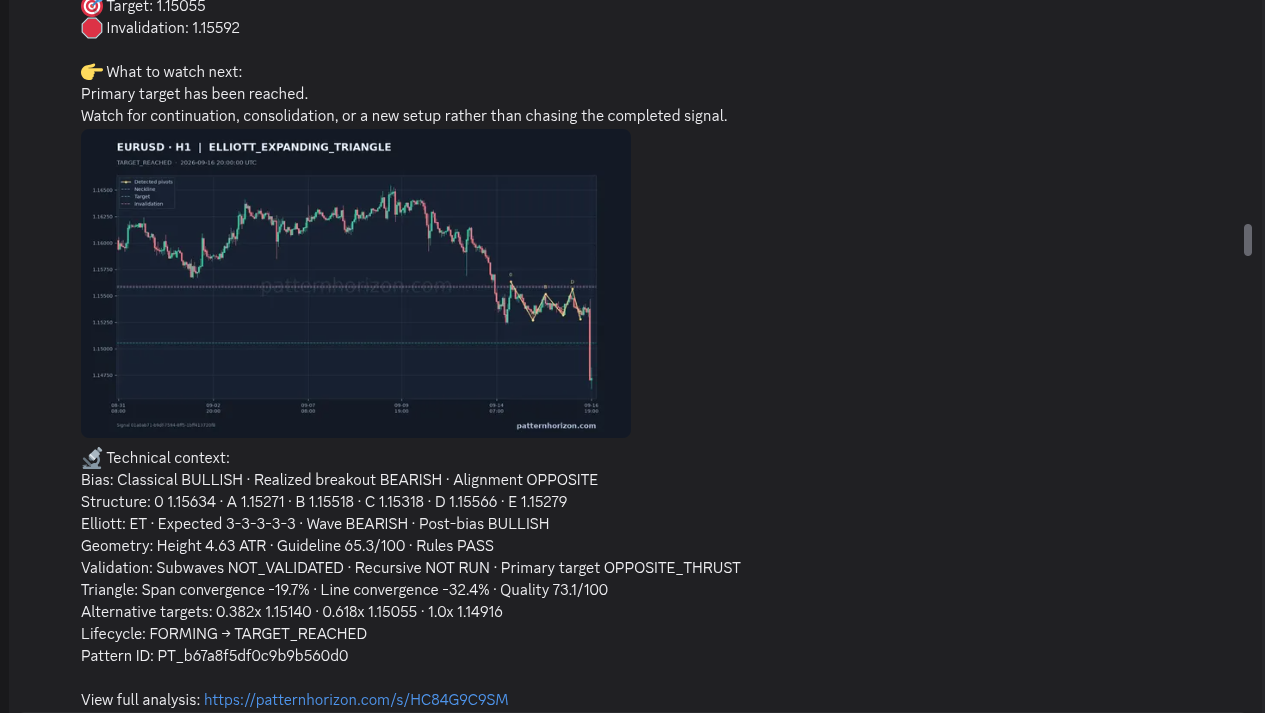
The illustrated EURUSD signal shows Classical BULLISH, Realized breakout BEARISH, and Alignment OPPOSITE. The signal later recorded TARGET_REACHED in the bearish direction. The fields tell a chronological story: a recognizable pattern had a bullish textbook orientation, price produced valid evidence in the other direction, and the lifecycle tracked the realized bearish path.
This is not a contradiction. Pattern detection and market resolution are separate observations. Retaining the classical label shows what the structure was; retaining the opposite breakout shows what price did. If the system changed the classical bias after the event, users would lose the distinction needed to study opposite resolutions honestly.
One completed example does not prove that opposite breakouts are generally more or less successful. Performance questions require a defined dataset across symbols, timeframes, pattern families, confirmation rules, targets, invalidations, and unresolved cases.
Read the Quality guideBefore a breakout
While a setup is FORMING, CANDIDATE, or AWAITING_CONFIRMATION, the classical bias can already be known from the pattern definition. The realized breakout may still be NEUTRAL because price has not satisfied the configured breakout condition. Alignment should therefore remain NEUTRAL rather than pretending that the expected direction has occurred.
This distinction matters around the Breakout level. Price can approach, touch, or briefly pass a reference without meeting all confirmation requirements. AWAITING_CONFIRMATION with Direction NEUTRAL tells the user that the structure is being monitored but the decisive event is not yet recorded. Quality can be HIGH at the same time because structural fit and breakout realization answer different questions.
Do not interpret NEUTRAL as an equal 50/50 probability or as evidence that the pattern lacks value. It means the comparison between classical and realized direction is not presently directional. The useful next step is to read Status, Action, the relevant boundary, Invalidation, and What to watch next.
Direction is another layer
The headline Direction summarizes the current orientation used for the signal. When a realized breakout is available, the direction can follow that event. This is why an OPPOSITE setup can display Direction BEARISH even though Technical context still says Classical BULLISH. The headline answers where the realized setup points now; the context explains how that direction relates to the original pattern.
For zone signals, direction is derived differently. A support rejection can be BULLISH, a resistance rejection can be BEARISH, a broken support can be BEARISH, and a broken resistance can be BULLISH. Before reaction or break evidence, a zone can remain NEUTRAL.
When conflict is detected, the integrated Direction can become UNCLEAR. That does not erase the underlying pattern's bias or breakout. It warns that nearby opposing evidence prevents those individual facts from supporting a clean overall edge. Read Direction as a summary, then use Technical context to understand its ingredients.

A different kind of conflict
OPPOSITE compares a pattern's classical bias with its realized breakout. Zone conflict compares nearby support and resistance evidence. The two concepts can coexist, but they answer different questions.
An OPPOSING_ZONE_CONFLICT can occur when support and resistance overlap or compete on the same timeframe. A CROSS_TIMEFRAME_ZONE_CONFLICT can occur when the immediate structure on one timeframe meets an opposing zone from another. In those situations, Pattern Horizon can show Action: WAIT / NO CLEAR EDGE and Direction: UNCLEAR, even if an individual pattern elsewhere in the message has a clear classical or realized direction.
The orange conflict presentation is intentionally cautious. It asks the user to wait for price to leave the overlapping area and look for a clear reaction or confirmed breakout before reassessing direction. It does not predict which zone must win.
Read the zone conflict guideHow the layers combine
Suppose an H1 pattern confirms a bullish breakout in CLASSICAL alignment while price is entering H4 resistance. The H1 pattern fields can be internally consistent: bullish classical bias, bullish realized breakout, and CLASSICAL alignment. At the same time, the higher-timeframe resistance can create cross-timeframe conflict. The correct combined reading is not that one field must be wrong; it is that local pattern evidence meets a broader obstacle.
Another setup can have OPPOSITE alignment and still avoid a zone conflict if the realized direction moves into open space. Conversely, a pattern with CLASSICAL alignment can still receive a cautious integrated reading when opposing support or resistance is too close. Alignment therefore does not measure the entire market context.
Keep the levels attached to their source. Record which timeframe produced the pattern, which timeframe produced each zone, where current price sits, and whether the conflict state is active. A lower-timeframe confirmation cannot automatically remove a higher-timeframe barrier, and a higher-timeframe zone does not prove that every lower-timeframe move will fail.
Do not create a synthetic score
Quality evaluates structural fit under the criteria available for that pattern. Alignment compares classical and realized direction. Probability, when available, is selected according to the lifecycle stage and direction. These values should not be added together or converted into an invented confidence score.
A HIGH-quality setup can remain NEUTRAL while awaiting confirmation. It can later become CLASSICAL or OPPOSITE depending on the realized breakout. Either path can reach a target or fail. Similarly, CLASSICAL alignment does not mean the Quality must be HIGH, and OPPOSITE does not mean the pattern was low quality.
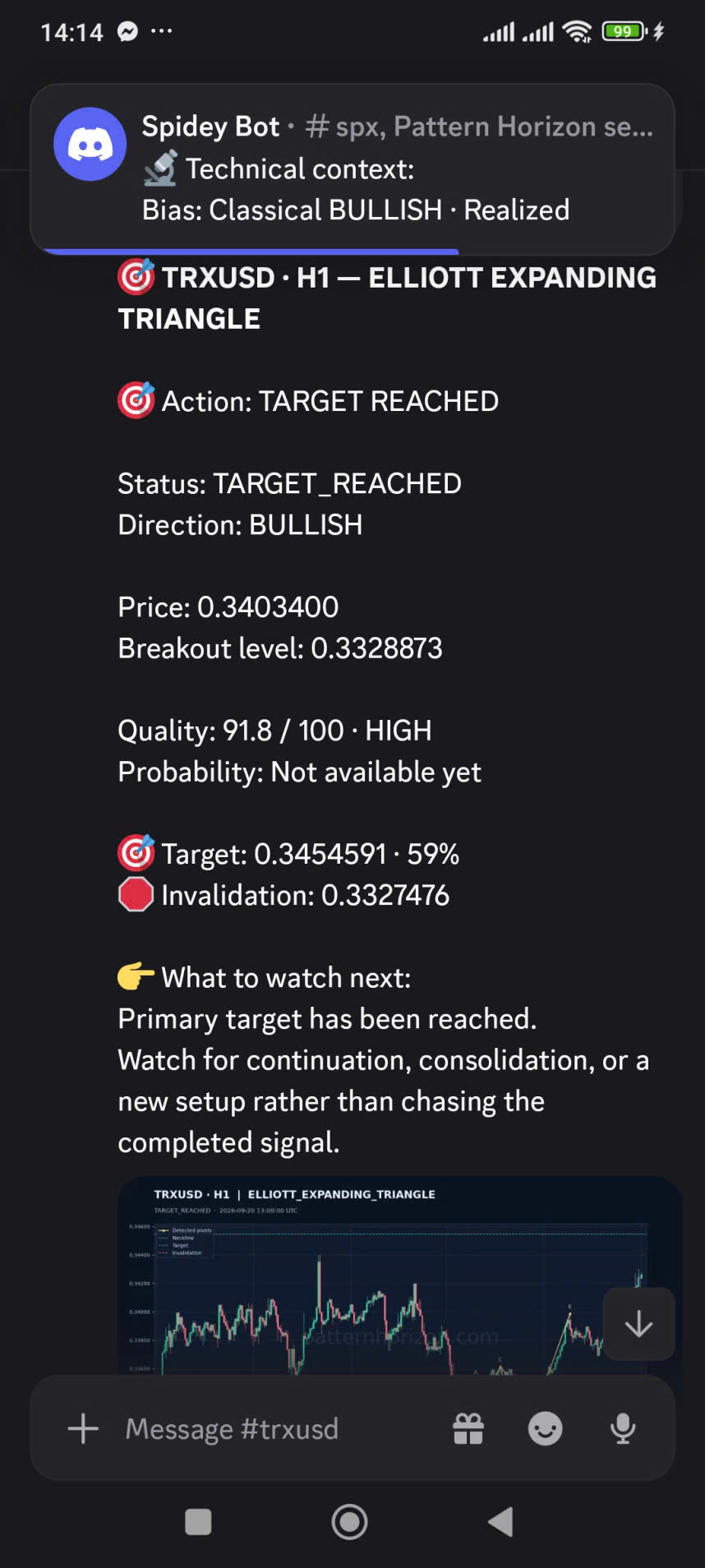
When a directional probability is present after confirmation or break, verify whether it corresponds to the classical or opposite direction. When the signal says “Probability: Not available yet,” treat the value as unavailable—not as zero, 50%, or certainty. The labels preserve different dimensions precisely so users can inspect them without blending them into a misleading number.
A disciplined reading sequence
This order separates pattern identity, observed events, and integrated context before any independent decision.
Do not transfer bias, breakout, alignment, or zones from one analytical horizon to another.
Determine whether the setup is still forming, awaiting confirmation, confirmed, completed, invalidated, or conflicted.
Treat it as the pattern's conventional orientation, not as proof of the next market move.
Check whether an observable direction has been recorded or remains NEUTRAL.
CLASSICAL means agreement, OPPOSITE means disagreement, and NEUTRAL means the comparison is unresolved.
Locate nearby opposing support or resistance and identify which timeframe produced each layer.
Use the levels that belong to the realized setup; neither alignment label guarantees the outcome.
Open the full signal, verify current conditions, and apply your own controls for volatility, liquidity, spread, slippage, leverage, and possible loss.
Common reading errors
The first mistake is treating Classical bias as the signal Direction before confirmation. The second is treating OPPOSITE as proof that the opposite move must continue. The third is assuming CLASSICAL means low risk. All three remove uncertainty that the fields were designed to preserve.
Another mistake is mixing OPPOSITE alignment with support/resistance conflict. OPPOSITE is a comparison inside a pattern's technical context. Conflict describes competing zones or timeframes and can override the integrated reading with UNCLEAR or WAIT / NO CLEAR EDGE. They can occur together or separately.
Do not ignore lifecycle. A pattern can become CONFIRMED and later FAILED; another can reach its target. The alignment label explains the relationship at breakout, not the final result. Do not ignore timestamps either: a newer state can supersede an older notification. Telegram and Discord are delivery channels, while the website provides the fuller analysis and history.
About performance claims
Screenshots of one classical target and one opposite target cannot establish which alignment is more accurate. A credible comparison must define pattern family, symbol, timeframe, sample period, Quality threshold, confirmation rule, target construction, invalidation, expiry, transaction assumptions, and treatment of unresolved setups. It must include all eligible signals rather than selecting memorable outcomes.
Results can also differ by market regime. A pattern family may produce more opposite resolutions during volatile or transitional periods and more classical resolutions in another environment. That possibility should be tested, not used as a claim without evidence.
Until a reviewed performance report exists, Pattern Horizon should present alignment as structured explanatory data. It helps users understand whether price followed or opposed the classical pattern orientation; it does not promise a win rate, profit, or suitable strategy.
Preserve both expectation and evidence
Open a signal and compare its headline Direction with the Technical context and current lifecycle state.
View signalsImportant information
Pattern Horizon provides market information and educational content only. Classical bias, realized breakout, Alignment, Direction, Quality, Probability, zones, targets, and invalidation levels are not personalized investment advice and do not guarantee profit or prevent loss. Patterns can fail, break in either direction, encounter conflicting structures, or change as new data arrives.
Independently verify current prices and conditions, understand the instrument, and account for liquidity, volatility, spread, slippage, leverage, and possible loss. Decide whether any setup fits your own method and circumstances, and seek qualified professional advice where appropriate.