
1. Verify the exact setup
Check symbol, timeframe, pattern type, timestamp, and Pattern ID so an older or similar-looking notification is not mistaken for the current event.
Article
Understand the difference between a pattern candidate, a setup awaiting confirmation, and a confirmed signal—and learn how breakout levels, invalidation, quality, and lifecycle updates work together.
Pattern lifecycle guide
A detected pattern is not automatically a confirmed pattern. Pattern Horizon separates early structure, waiting conditions, confirmation, and invalidation so users can see what the market has actually demonstrated instead of treating every candidate as a completed signal.
Detection comes first
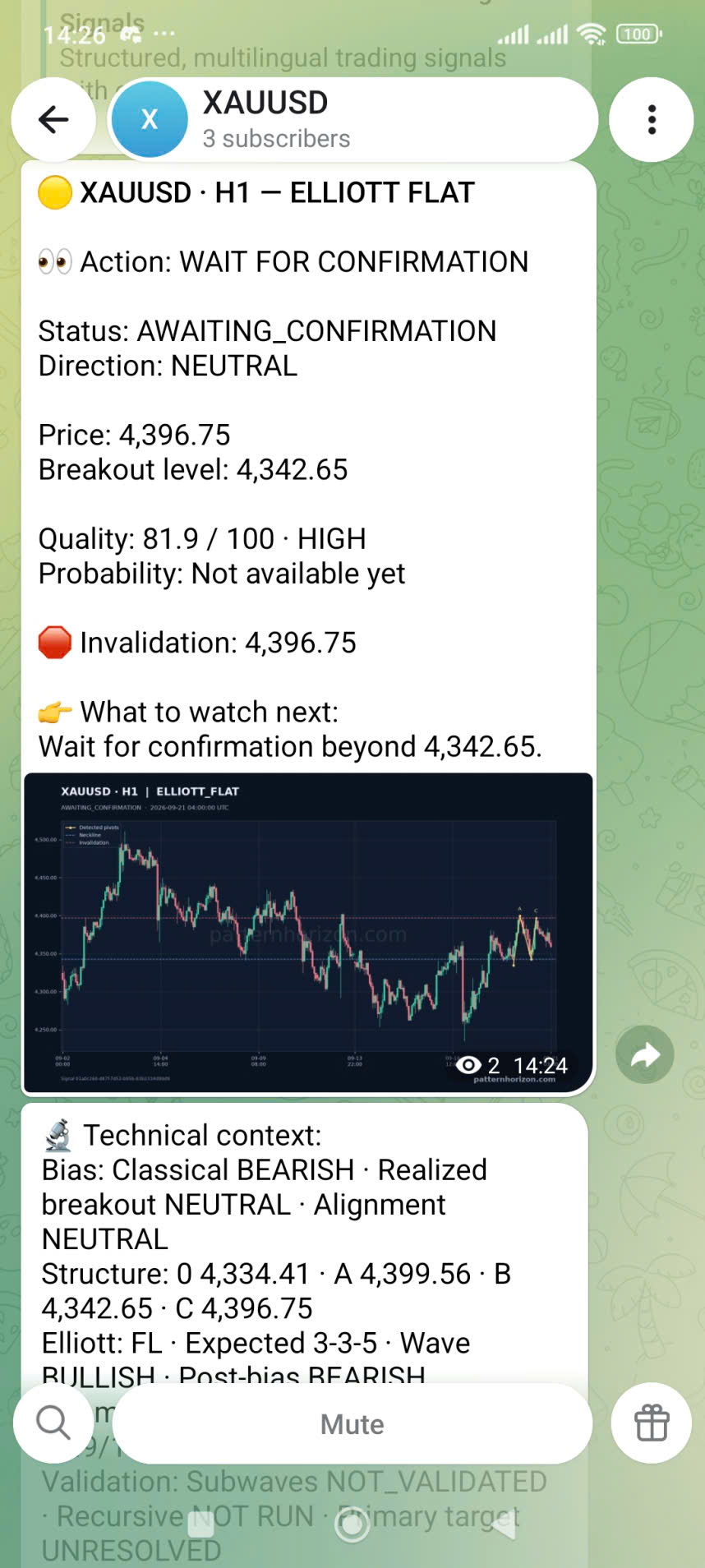
Pattern detection begins when the system identifies price pivots and relationships that resemble a supported structure. At this stage, the market may have supplied enough information to describe a candidate, but not enough to confirm the scenario’s directional transition. The distinction is essential: detection says “this geometry is present”; confirmation says “the configured confirming condition has now been recorded.”
Many chart-reading errors occur when those two statements are collapsed into one. A trader sees a nearly complete Elliott correction, a cup-and-handle outline, or another familiar formation and mentally promotes it to confirmed. But the final leg can extend, the boundary can hold, the pattern can become more complex, or price can cross invalidation first. Pattern Horizon keeps the lifecycle explicit so uncertainty is visible rather than hidden.
The status can therefore begin as FORMING or CANDIDATE where supported. Action may be WATCH, and Direction may remain NEUTRAL while the structure develops. These are not weak versions of CONFIRMED; they are different stages with different evidence.
Three stages
FORMING or CANDIDATE means the system is monitoring an incomplete or provisional structure. The expected pivots or geometry may still change. The appropriate question is whether the remaining structure can complete without violating its rules or invalidation condition.
AWAITING_CONFIRMATION means the setup has advanced far enough for the system to identify a confirmation requirement, but that requirement has not yet been recorded. The message normally pairs this status with WAIT FOR CONFIRMATION and provides a Breakout level or key boundary. Direction can be NEUTRAL at this stage because the platform is deliberately withholding a stronger directional conclusion.
CONFIRMED means the configured confirmation event has occurred and been processed. Action can become SETUP CONFIRMED, while Direction reflects the realized orientation. Confirmation improves the evidence for the setup’s next phase; it does not guarantee that price will continue to the target. Invalidation, later conflict, or a failed outcome can still occur.
Read these stages as a sequence of evidence, not as three confidence labels. A HIGH-quality setup can remain AWAITING_CONFIRMATION, while a more moderate structure may eventually become CONFIRMED because price satisfied its defined condition.
The price reference
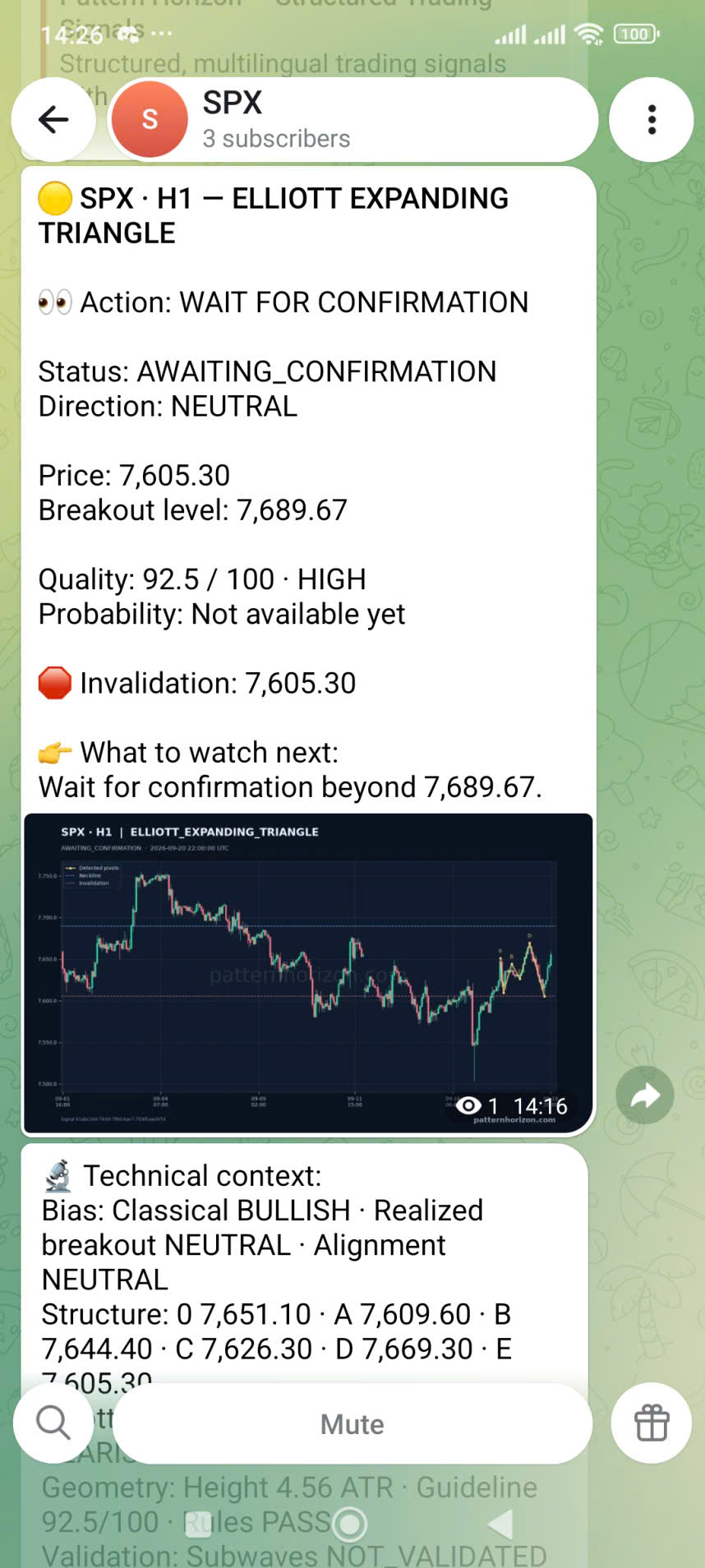
A message may say “Breakout level: 7,689.67” and “Wait for confirmation beyond 7,689.67.” This provides the boundary associated with the pattern’s confirmation logic. It does not mean the user should place an automatic order at that number, nor does it mean a momentary visual touch is enough to override the displayed status.
The signal status is the platform’s record of whether the configured condition has been met. Different detectors can apply different structural requirements, so users should not invent a universal candle-close rule, wick rule, or time delay that the message does not state. If price appears to cross the boundary while the latest signal still says AWAITING_CONFIRMATION, verify timing, current price, and the newest event on the website. Processing schedules, market feeds, and delivery channels can introduce delay.
The boundary should always be read with Invalidation. Confirmation describes what advances the thesis; invalidation describes what ends it. Price can approach the confirmation level repeatedly and still invalidate the structure first.
Review signal detailsQuality is not confirmation
Quality evaluates structural fit; confirmation records a lifecycle event. The SPX example carries a HIGH Quality score while Action remains WAIT FOR CONFIRMATION, Status remains AWAITING_CONFIRMATION, and Direction remains NEUTRAL. This combination is internally consistent. The structure can look strong according to the detector while price has not yet provided the required confirming evidence.
Guideline score and Rules PASS also should not be mistaken for market confirmation. Rules PASS means the encoded geometry satisfies the applicable structural rules. Guideline score indicates how closely it follows softer pattern guidelines. Subwave validation and recursive validation concern internal Elliott structure. These fields help evaluate the candidate, but the Breakout level and lifecycle status answer whether the external confirmation event has occurred.
This separation prevents hindsight from entering the analysis. Before confirmation, the system can show what is promising and what remains missing. After confirmation, the event history records when the transition occurred. If invalidation comes first, the history preserves that outcome instead of pretending the setup was never detected.
The alternative path
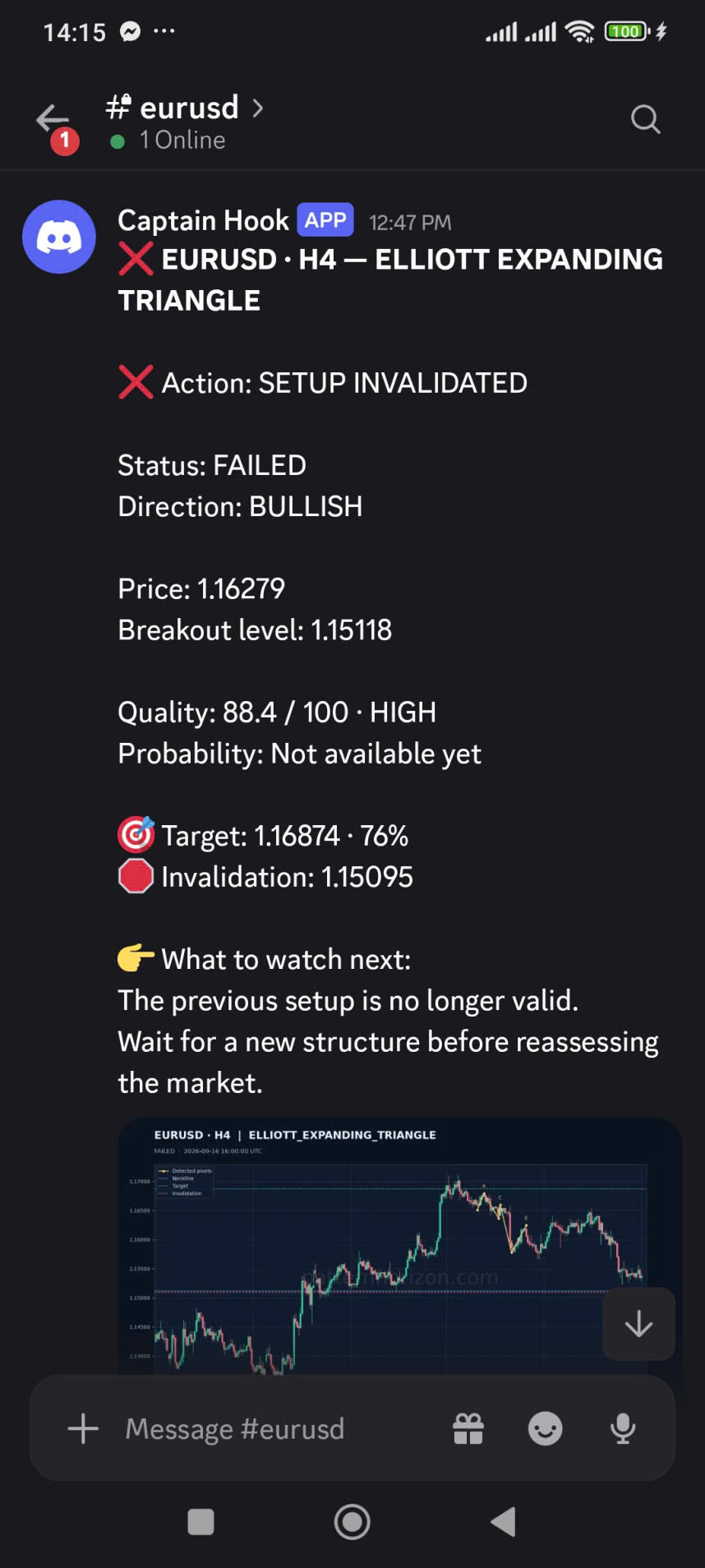
Not every candidate completes. Price may violate the pattern’s invalidation condition while the setup is still forming or awaiting confirmation. Pattern Horizon then records FAILED or an invalidated state and changes the Action to SETUP INVALIDATED. The correct next step is to wait for new structure before reassessing the market.
A failed candidate is not wasted information. It shows that the market did not satisfy the conditional thesis and documents the boundary that ended it. This is more useful than treating every early detection as a trade and explaining failures only after the fact.
Invalidation is not an automatic reversal signal. If a bullish candidate fails, the evidence for that bullish setup has ended; a bearish thesis still needs its own structure and confirmation. Likewise, the displayed invalidation price describes the model’s setup boundary, not a personalized stop-loss. Position size, volatility, liquidity, spread, slippage, and account risk remain separate decisions.
Open the signal feedConfirmation in context
Confirmation belongs to the symbol, timeframe, pattern instance, and boundary shown in the signal. An H1 pattern becoming CONFIRMED does not mean every H4 or D1 structure on the same symbol agrees. Another timeframe may show nearby resistance, support, an opposing pattern, or a different lifecycle state.
Technical context helps expose those differences. Classical bias describes the pattern’s conventional orientation. Realized breakout records the direction that actually occurred when available. Alignment reports whether the breakout followed the classical direction or moved opposite to it. Zone context can identify OPPOSING_ZONE_CONFLICT or CROSS_TIMEFRAME_ZONE_CONFLICT. In those conditions, Pattern Horizon may show WAIT / NO CLEAR EDGE or UNCLEAR rather than forcing a directional reading.
Confirmation is therefore specific, not universal. It confirms the configured event for one setup. A disciplined reader still checks the broader context, current price, invalidation, and whether the analytical horizon matches the intended method.
Before treating a setup as confirmed
The sequence is intentionally simple so it can be repeated when a Discord or Telegram notification arrives.
Check symbol, timeframe, pattern type, timestamp, and Pattern ID so an older or similar-looking notification is not mistaken for the current event.
WATCH and WAIT FOR CONFIRMATION are not CONFIRMED. Use the latest recorded lifecycle state rather than visual anticipation.
Compare current price with the Breakout level or key boundary, while remembering that proximity alone does not change status.
Understand what ends the setup before focusing on target projections. A candidate can fail before confirmation.
Inspect rules, guideline score, subwave status, classical bias, realized breakout, alignment, and nearby zone conflicts where available.
Use the website timeline to confirm that the message is current, then make an independent decision based on present market and personal risk constraints.
After confirmation
Once confirmation is recorded, the questions change. Instead of asking whether the boundary event occurred, review whether price is following through, how far it is from the primary target and invalidation, and whether new market context has appeared. The applicable Probability field may also change from formation probability to a directional value based on the realized direction.
A confirmed setup can later reach its target, fail, expire, consolidate, or produce another supported lifecycle event. The first confirmation message should not be preserved mentally while newer events are ignored. Follow the same Pattern ID and use the website timeline to see the latest state.
If TARGET_REACHED is recorded, the primary tracked milestone is complete. The appropriate response is not to chase the old signal but to watch for continuation, consolidation, or a new setup. If FAILED is recorded, the old thesis is closed. Confirmation increases evidence at one point in the lifecycle; it does not suspend uncertainty for everything that follows.
Common mistakes
The most common mistake is entering mentally or financially while the message still says AWAITING_CONFIRMATION, then treating a later failure as unexpected. A second mistake is assuming HIGH Quality substitutes for the missing event. A third is interpreting a touch of the boundary from a small screenshot without checking the current signal. A fourth is ignoring invalidation because the target appears attractive.
Another error is assuming confirmation always follows the classical direction. Realized breakout can align with the classical bias or move opposite to it. Read Direction and Alignment after the event instead of assuming the pattern name decides the outcome in advance.
Finally, do not compare confirmation rates across H1, H4, and D1 using a handful of examples. A valid comparison needs a defined sample, period, symbol universe, pattern family, lifecycle rules, and treatment of incomplete setups. Until that analysis exists, timeframe should be understood as analytical scope—not a guarantee of accuracy.
Wait for recorded evidence
Review current Pattern Horizon signals and practice distinguishing a promising structure from a confirmed setup.
View signalsImportant information
Pattern Horizon provides market information and educational content only. Pattern detections, confirmation states, Quality scores, probabilities, targets, and invalidation levels are not personalized investment advice and do not guarantee results. Confirmed patterns can fail, market conditions can change quickly, and actual execution may differ from displayed prices.
Independently verify current information, understand the instrument and timeframe, account for spread, slippage, liquidity, leverage, and possible loss, and decide whether a setup fits your own method and circumstances. Seek qualified professional advice where appropriate.