
1. Verify symbol and timeframe
The value belongs to a particular signal and analytical horizon; do not transfer it to another setup.
Article
Learn how Pattern Horizon selects formation, directional, target, and confidence fields across the signal lifecycle—and why Probability, Confidence, and Quality must not be treated as interchangeable.
Signal metrics guide
The word Probability appears as one line in a notification, but the value behind that line can depend on the signal's lifecycle stage and realized direction. Confidence can be used for later states when corresponding data exists. Quality remains a separate structural assessment. Understanding which question each field answers is more important than simply choosing the largest percentage.
One line, stage-dependent meaning
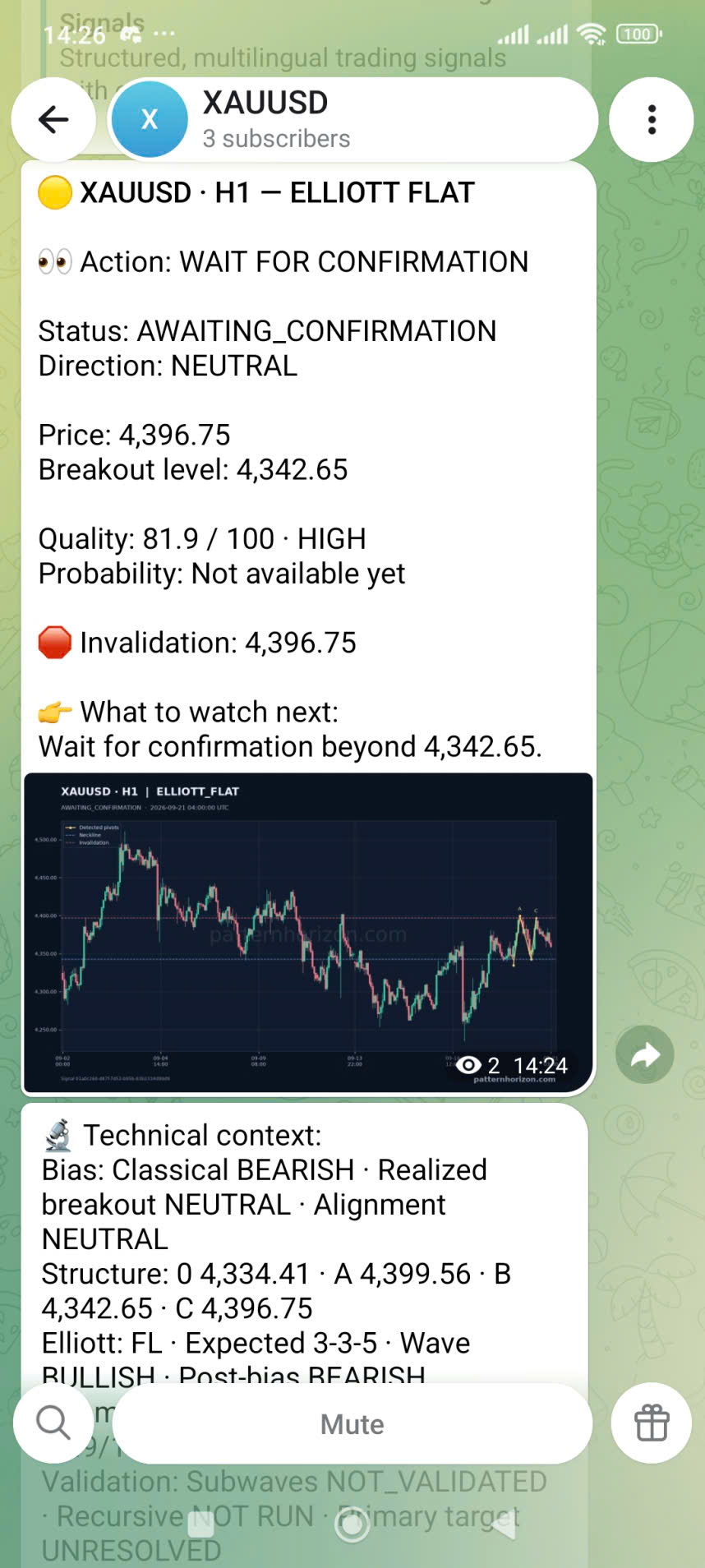
Pattern Horizon does not treat every percentage as the same prediction. During CANDIDATE, FORMING, or AWAITING_CONFIRMATION, the Probability line uses formation probability when that field is available. The question is associated with the developing formation—not with guaranteed profit.
During CONFIRMED or BROKEN, the displayed probability is selected according to the realized Direction. If Direction agrees with Classical bias, the classical-direction probability is relevant. If the realized direction is opposite to the classical bias, the opposite-direction probability is selected.
For later states outside those groups, the renderer can use Confidence when a confidence score is available. At TARGET_REACHED, delivery routing can separately use primary target probability when configured. The key principle is that lifecycle and direction determine which available field is relevant; the headline does not represent one universal model output across every state.
Early lifecycle
A candidate pattern can have recognizable pivots and geometry before it is complete. Formation probability, when available, belongs to that early-stage question. It can help the system or user understand a developing candidate without pretending that confirmation or a target outcome has already occurred.
The value should be read with Status. AWAITING_CONFIRMATION still means the configured confirmation condition has not been recorded. Even a high formation probability cannot advance the lifecycle by itself. Price can fail to complete the structure, cross invalidation, expire, or break in an unexpected direction.
Formation probability is also not a personal trade success rate. It does not incorporate an individual's entry, exit, size, costs, or ability to execute. Use it as one structured field inside the signal, after verifying symbol, timeframe, pattern, Quality, and the condition being awaited.
Missing data has a precise meaning
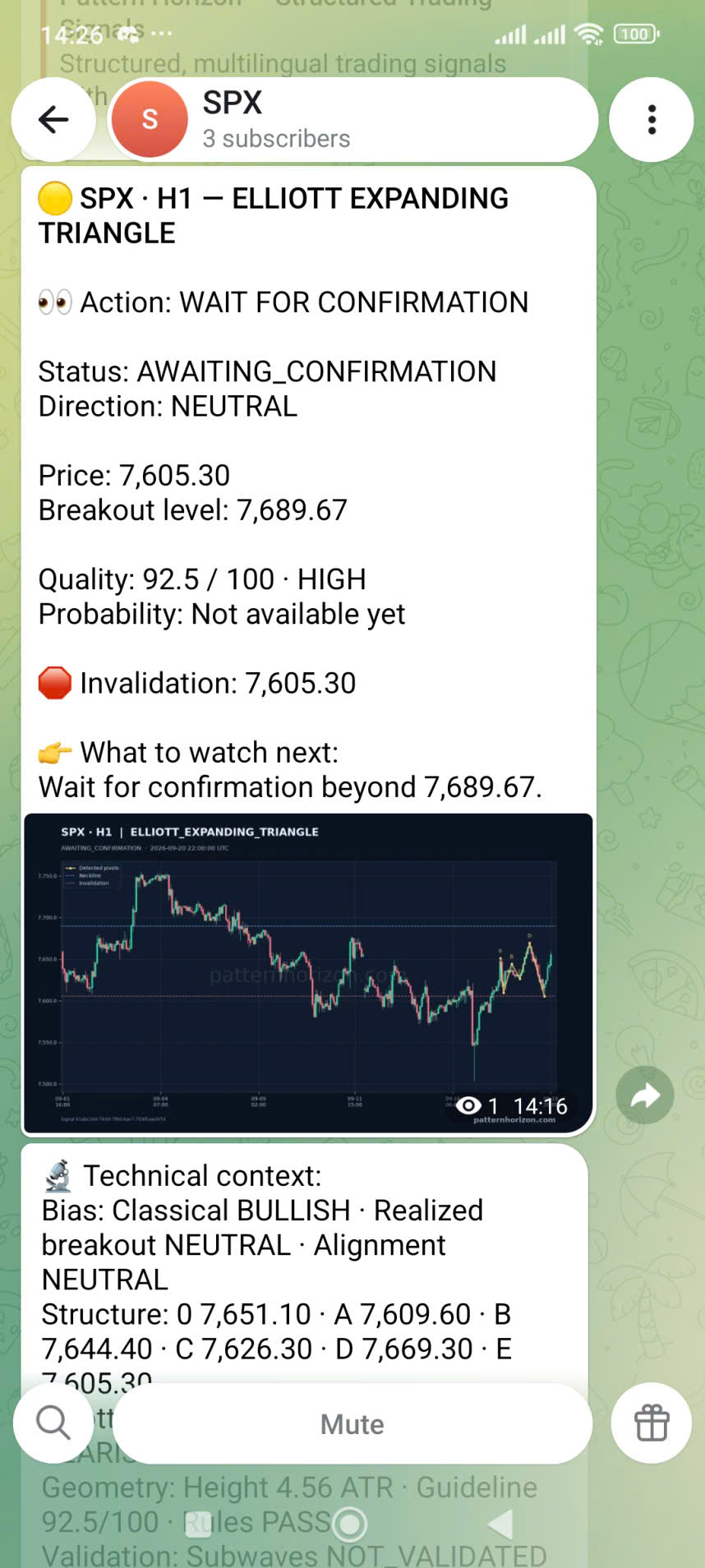
The illustrated signal is AWAITING_CONFIRMATION with HIGH Quality, while Probability says Not available yet. There is no contradiction. Quality describes how well the detected structure fits applicable criteria; Probability is unavailable for the current stage or signal data.
The phrase should be read literally. The platform is not silently assigning a neutral probability, and the user should not fill the gap with a guessed number. Missing probability does not convert Quality 81.9/100 into an 81.9% chance of success.
The appropriate next question comes from the Action and What to watch next sections: wait for confirmation beyond the relevant boundary, or wait for the configured condition. Absence of a percentage preserves uncertainty instead of presenting unsupported precision.
Read the confirmation guideAfter confirmation or break
Once a setup is CONFIRMED or BROKEN, the signal has realized directional evidence. Pattern Horizon compares that Direction with Classical bias. If they agree, the classical-direction probability is the relevant value. If the breakout occurred in the other direction, the opposite-direction probability is selected.
This design matters because patterns do not always resolve classically. A bullish textbook pattern can break bearish, or a bearish pattern can break bullish. Displaying only the classical-direction probability after an opposite breakout would answer the wrong question. Alignment records whether the relationship is CLASSICAL or OPPOSITE, while the Probability line follows the realized path when data exists.
Directional probability still does not guarantee that Target will be reached. Confirmation records a boundary event; follow-through, target, invalidation, and later context remain uncertain.
Later lifecycle fields
For states outside forming and confirmed/broken selection, the signal presentation can use Confidence when a confidence score is available. This provides a later-stage field without pretending that formation probability or directional probability still answers the same question.
Confidence should remain attached to its definition and state. It is not automatically a calibrated chance of profit, and it should not be used to reconstruct a missing formation or target probability. If no corresponding value is available, the interface continues to show Not available yet.
Users should also distinguish the headline Probability line from the percentage displayed beside Target. The target suffix represents primary target probability when available. A message can therefore have a Target percentage while the general Probability line is unavailable. Those values come from different fields and should not be forced to match.
Outcome and estimate are different
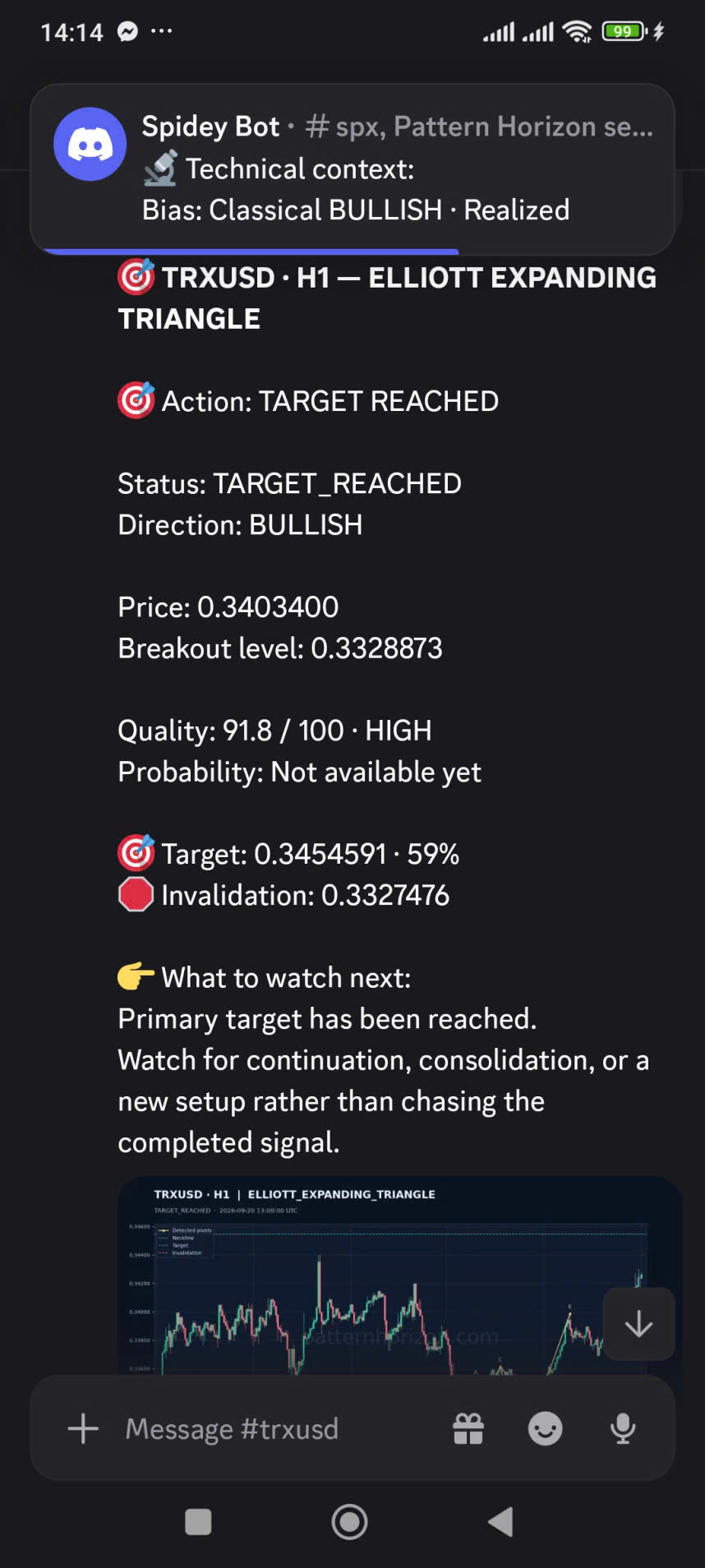
The illustrated Discord result shows a Target price followed by a percentage and a lifecycle state of TARGET_REACHED. The percentage belongs to the primary target probability field. It does not describe progress toward the target, price return, account return, or the share of a position that should be closed.
TARGET_REACHED is the observed result. Target probability is an estimate field associated with the objective. Keeping the estimate and result visible allows later analysis without rewriting the earlier context. A reached target does not retroactively make its probability 100%, and a failed setup should not retroactively be assigned 0%.
Performance evaluation requires many comparable signals, including all outcomes and unresolved cases. One screenshot is useful for learning the fields, not for estimating a system-wide win rate.
Read the Target guideKeep the metrics separate
Quality evaluates structural fit under the rules, geometry, guidelines, or zone criteria applicable to the detection. Formation probability concerns the developing setup. Directional probability follows the classical or opposite realized path after confirmation. Target probability concerns the primary tracked objective. Confidence can be used for applicable later states.
Because they answer different questions, the numbers must not be averaged, added, multiplied, or ranked as though they formed a single universal score. Quality 90/100 plus a Target probability of 70% is not 160 points of confidence. Multiplying them does not create a supported 63% success rate.
A clean structure can fail; a medium-quality structure can reach its target; a high formation probability can remain unconfirmed; and a confirmed setup can invalidate before target. The lifecycle records these distinctions rather than hiding them behind one headline number.
A seven-step metric review
This sequence prevents a percentage from being detached from its state and label.
The value belongs to a particular signal and analytical horizon; do not transfer it to another setup.
Identify whether the setup is forming, awaiting confirmation, confirmed, broken, completed, failed, expired, or ambiguous.
Determine whether the context calls for formation, classical-direction, opposite-direction, target probability, or confidence.
After breakout, verify whether realized direction is CLASSICAL or OPPOSITE before interpreting a directional estimate.
Use structural assessment to understand the detection, not as a replacement percentage when probability is unavailable.
An estimate cannot replace the objective and hypothesis boundary that the lifecycle actually tracks.
Verify current conditions and account for volatility, liquidity, spread, slippage, leverage, and possible loss.
Responsible interpretation
A useful probability model should be evaluated on outcomes collected under a fixed definition. Calibration asks whether events assigned similar probabilities occur at comparable frequencies over a sufficiently large sample. Coverage asks how often the field is actually available and which states, symbols, timeframes, and pattern families it represents. Sample size determines how much uncertainty remains around the observed result.
A report should state its period, dataset, target and invalidation rules, expiry handling, treatment of open setups, and whether probabilities were frozen before the outcome. Selecting only completed or favorable alerts would bias the analysis.
Even a well-calibrated market estimate does not predict an individual trade's net result. Execution costs, entry timing, order behavior, and account decisions sit outside the percentage shown in the signal. Historical calibration also does not guarantee future performance when market conditions change.
Common mistakes
Avoid treating Quality as probability, Target probability as expected return, or Confidence as a universal replacement for unavailable fields. Do not read Not available yet as 50%, and do not interpret a high percentage as confirmation when Status still says AWAITING_CONFIRMATION.
Do not compare percentages across unrelated lifecycle stages as if they measured the same outcome. A formation estimate and a target estimate answer different questions. Do not assume that a displayed number already includes your spread, slippage, leverage, or risk tolerance.
Finally, do not judge accuracy from a few TARGET_REACHED screenshots. Include FAILED, INVALIDATED, EXPIRED, AMBIGUOUS, and unresolved signals under a predefined analysis. The field is useful only when its meaning and evidence remain visible.
Read the label before the percentage
Open a signal and compare Status, Direction, Quality, Probability, Target, and Invalidation as separate fields.
View signalsImportant information
Pattern Horizon provides market information and educational content only. Quality scores, probability fields, confidence scores, targets, invalidation levels, directions, and statuses are not personalized investment advice and do not guarantee profit or prevent loss. Estimates can be unavailable, uncertain, or affected by changing market conditions.
Independently verify current prices and conditions, understand the instrument, and decide whether any setup fits your own method and circumstances. Account for liquidity, volatility, spread, slippage, leverage, and possible loss, and seek qualified professional advice where appropriate.