
Identify the market and timeframe
Confirm the symbol, timeframe, signal type, direction, and detection time before comparing the setup with your own chart or market source.
Article
Learn how to read a Pattern Horizon signal from its initial detection through state changes, confirmation, invalidation, expiry, or a recorded target event.
Signal education
A signal is not only its first alert. Learn how to connect its market context, current state, event history, and possible outcomes before making your own decision.
Start with context
A structured signal records a market observation and keeps later changes connected to the same setup. The first detection is therefore a starting point, not a final conclusion. As price and market structure develop, the signal may move through several states, remain unresolved for a period, or reach an outcome that closes the current lifecycle.
This distinction matters because an isolated notification can lose important context. A message saying that a pattern was detected does not explain whether price is still far from a relevant level, approaching it, waiting for confirmation, or already invalidated. Pattern Horizon groups these changes under one signal identifier so users can read the sequence rather than treating every update as a new recommendation.
The lifecycle is descriptive. It reports what the system has recorded according to its structured rules. It does not guarantee that a pattern will complete, that a target will be reached, or that a user can obtain the displayed price in a live market.
Signal anatomy
Begin with the symbol and timeframe. The symbol identifies the market, while the timeframe shows the interval in which the setup was evaluated. A pattern on a shorter timeframe and one on a longer timeframe may describe different market structures even when they refer to the same symbol.
Next, review the signal type, pattern label, and direction. Direction may be bullish, bearish, or neutral when applicable. It expresses the orientation of the detected scenario; it is not a personalized instruction to buy or sell. The displayed price or zone provides a reference for the observation, while the detected and updated timestamps show when the original event and latest change were recorded.
Only after establishing this context should you read the current status. A status without its symbol, timeframe, direction, and timing can be easy to misinterpret.
A practical reading method
Use the same sequence each time so that a prominent status or number does not distract you from the full setup.
Confirm the symbol, timeframe, signal type, direction, and detection time before comparing the setup with your own chart or market source.
Read the status as the latest recorded condition, then check whether it describes formation, approach, interaction, confirmation, or a terminal outcome.
Where available, inspect the key level or zone, target, invalidation level, and the guidance about what the system is monitoring next.
Use the ordered event history to understand how the signal reached its current state instead of relying only on the newest notification.
Compare the information with current prices, your venue, risk limits, and trading plan. A structured signal is an input, not an execution instruction.
Understanding states
Early states can include far, forming, or approaching. These labels indicate that the relevant structure is developing or that price is moving nearer to an area being monitored. They should not be read as confirmation that the expected scenario will occur.
Interaction states can include in zone, touching, or pierced. For zone-based signals, these describe how price relates to a structured area. Awaiting confirmation indicates that the system is looking for additional conditions before treating the setup as confirmed. Confirmed, rejected, and broken describe different recorded reactions, but their meaning still depends on the signal group, direction, level, and event history.
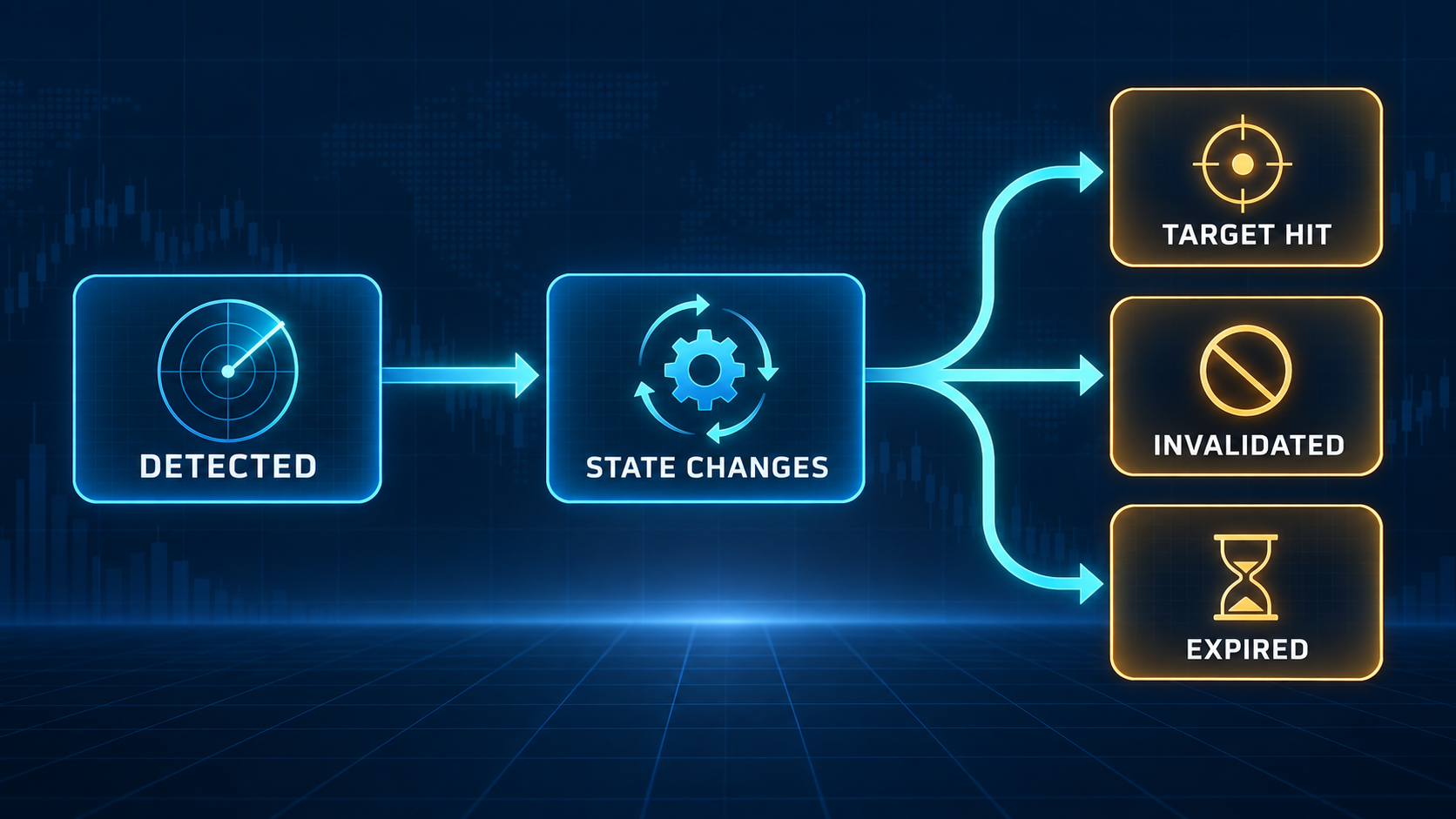
Terminal or resolving states can include target reached, invalidated, expired, or failed. These outcomes are alternatives; a signal does not move through all of them. It may also follow a shorter or more complex path than a simplified diagram suggests. Pattern Horizon preserves unfamiliar future status values with a safe fallback so that the lifecycle can evolve without turning an unknown label into a false interpretation.
Possible outcomes
The diagram illustrates a core principle: after detection, a signal can change state and eventually branch toward different outcomes. A target event, invalidation, or expiry should be read as a recorded lifecycle result, not as proof that every user entered, exited, or received the same execution price.
Some signals may be rejected, fail, remain ambiguous, or follow state combinations not shown in this simplified illustration. Always use the event history as the authoritative sequence for the individual signal.
Open the signal feedEvent history
Every lifecycle event belongs to the same signal and is ordered by sequence. The previous status and new status help explain the transition, while the event time records when the system observed it. Reading events from oldest to newest gives a clearer account than comparing notifications by arrival time alone.
Realtime delivery means an eligible update can appear through a secured connection after the platform records it. Network conditions, data processing, and external delivery channels can still introduce differences in arrival time. The canonical signal detail on the web is therefore the best place to confirm the current state and available history.
If a browser notification, Telegram message, or Discord message appears out of context, return to the signal detail and check the latest status, update time, and preceding events before interpreting it.
Scores and probabilities
Where available, quality, probability, target, invalidation, and technical-context fields add structure to the signal. A quality score summarizes defined characteristics; it is not a win rate. A probability field must be read with its label because it may refer to formation, direction, confidence, or another documented meaning. Values that are unavailable should remain unavailable rather than being guessed.
Targets and invalidation levels are scenario references, not guaranteed execution instructions. Spreads, slippage, gaps, liquidity, venue differences, and changing market conditions can all affect a real trade. The presence of more fields does not remove uncertainty; it helps users see what the system evaluated and what conditions matter next.
Access and delivery
Pattern Horizon checks the active plan and selected symbols before displaying or delivering protected signal information. Direct access to a known signal does not bypass entitlement rules. The same checks apply when lifecycle updates are sent through the secured realtime web connection.
Telegram and Discord are optional delivery channels for entitled symbols. Connecting either service changes where eligible information can arrive; it does not expand symbol access and does not turn the channel into a trading account. The web signal detail remains the main reference for the complete context.
Responsible use
Before acting, ask whether the signal is current, whether its direction and timeframe match your analysis, whether price has already moved materially, and where your own invalidation and risk limits would be. Also consider scheduled events, liquidity conditions, transaction costs, and whether your broker’s prices differ from the platform reference.
Do not treat confirmed as “certain,” target reached as evidence of universal profit, or invalidated as evidence that every possible strategy failed. These are structured descriptions of one detected setup. A disciplined reading process uses the lifecycle to understand change while keeping the final decision independent.
Apply the framework
Open the signal feed, choose an entitled symbol, and practice reading its fields and ordered history before focusing on the latest status.
View signalsImportant information
Pattern Horizon provides market information and educational context. It does not provide personalized investment advice, execute trades, or guarantee outcomes. Trading involves risk, including the possible loss of capital. Always conduct your own assessment and consider independent professional advice where appropriate.
## Suggested internal links