
1. Verify symbol and timeframe
Levels belong to one detected structure and should not be transferred to another symbol, timeframe, or later setup.
Article
Understand the difference between Breakout level, Target, and Invalidation in Pattern Horizon—and why these analytical references are not automatically a personal entry, take-profit, or stop-loss instruction.
Signal levels guide
A Pattern Horizon signal can show Price, Breakout level, Target, and Invalidation in the same message. These values do not perform the same job. The breakout boundary determines whether a setup advances; the target is the primary objective tracked by the lifecycle; invalidation marks the condition that ends the current hypothesis. Reading them as separate analytical references is essential before interpreting any signal.
Begin with four distinct fields
Price is the market reference recorded for the event or update. It tells you where price was when that signal state was generated; it is not necessarily the price available when a notification is opened.
Breakout level is the boundary used to evaluate confirmation or another meaningful transition. While a setup is AWAITING_CONFIRMATION, the message can say to wait beyond this value. Approaching, touching, or briefly crossing it is not automatically equivalent to meeting every configured confirmation condition.
Target is the primary price objective selected for lifecycle tracking when one is available. It allows the platform to determine whether the setup later reaches the defined objective. It is not a promise and it does not necessarily match an individual user's exit method.
Invalidation is the price condition that makes the current setup interpretation no longer valid. Crossing it can lead to FAILED or INVALIDATED. It closes the previous hypothesis; it does not automatically confirm the opposite direction.
Before confirmation
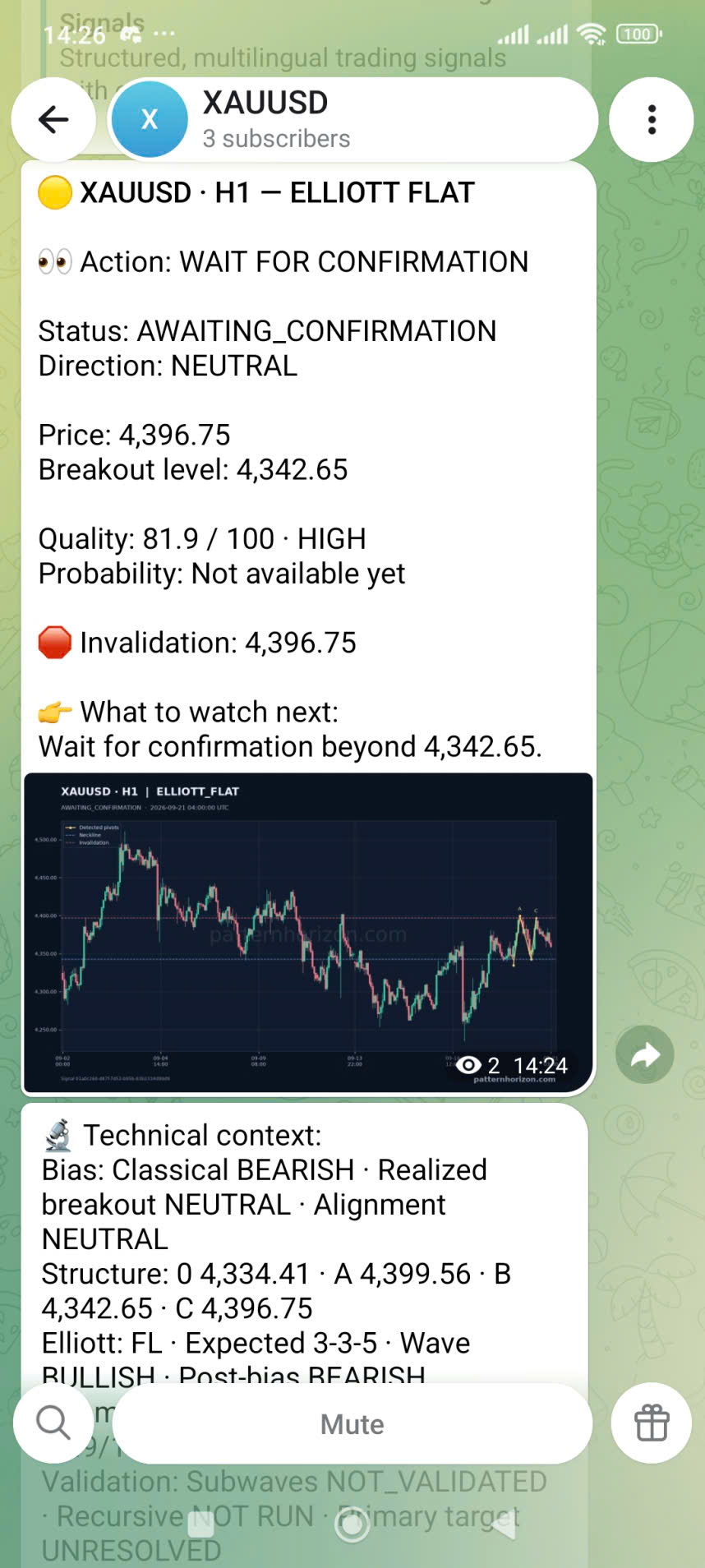
In an AWAITING_CONFIRMATION message, the most important relationship is often between current Price, the Breakout level, and Invalidation. The setup has developed enough structure for the system to define what would advance it and what would end it, but the decisive event has not yet been recorded.
This is why the Action says WAIT FOR CONFIRMATION. A visible level is not an invitation to enter in advance. Price can stop before the boundary, cross it without satisfying the configured evidence, return into the structure, or move through invalidation first. The lifecycle records what actually happens rather than assuming the expected path.
A Target may already be available for the candidate, but it remains conditional on the setup surviving and progressing. Read Status literally. A future objective does not turn an unconfirmed candidate into a confirmed signal.
The target belongs to the detected setup
Target construction can depend on the pattern family, its geometry, the realized direction, and the target type selected by the signal engine. Elliott messages can also show alternative targets derived from applicable ratios, while the headline Target identifies the primary objective being tracked for the lifecycle.
The displayed value is a reference generated from the detected structure. It does not account for the exact entry price, order type, spread, fees, slippage, liquidity, leverage, account size, or tax situation of an individual user. Consequently, reaching the displayed Target is not identical to every user earning a particular return.
Do not move a Target from one timeframe or signal to another. An H1 target belongs to its H1 structure; an H4 setup can have different boundaries and timing. If a newer signal replaces or invalidates the previous interpretation, use the latest lifecycle and history rather than continuing to treat the old target as active.
The percentage beside Target
When the message shows a percentage beside Target, that suffix represents the available primary target probability field. It is not the percentage of the distance already traveled. It is not the expected profit percentage, and it is not a guarantee that the target will be reached.
Keep the value attached to its label and lifecycle context. A target probability can be available even when the separate headline Probability field uses a different stage-relevant value or says Not available yet. The two locations may represent different fields and should not be merged.
Do not multiply Target probability by Quality, use it as position size, or convert it into a personalized risk/reward forecast. Any probability estimate depends on its underlying definition and data. It cannot include future events or the execution circumstances of a specific account.
A completed objective
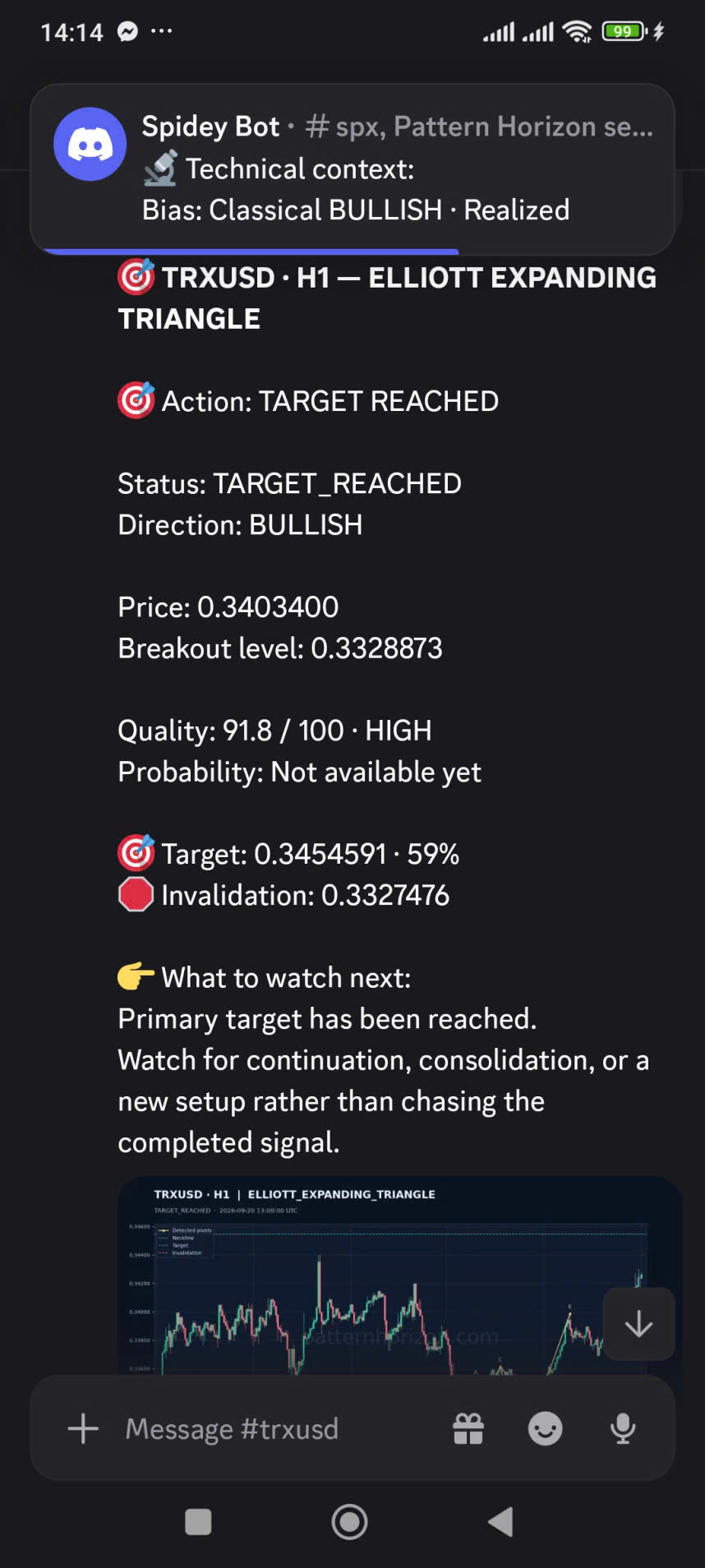
The illustrated Discord update shows Action: TARGET REACHED and Status: TARGET_REACHED. The primary target has already been recorded as reached. The message therefore advises watching for continuation, consolidation, or a new setup rather than chasing the completed signal.
Notice that Breakout level, Target, Invalidation, Quality, and Direction remain visible. They preserve the setup's context and make the outcome reviewable. The Target percentage is not a statement that the user earned that percentage, and the historical event price may differ from a later executable price.
A completed target is one lifecycle result. It does not establish the win rate of a pattern family, timeframe, or platform. Honest performance analysis must include failed, expired, ambiguous, and still-open setups under a defined method.
Read the status dictionaryThe hypothesis boundary
Invalidation is the boundary beyond which the present structural interpretation should no longer be carried forward. Before confirmation, it can prevent an incomplete formation from becoming a valid setup. After confirmation, it can mark where the realized hypothesis fails to maintain the conditions being tracked.
The purpose is analytical discipline. Without an invalidation condition, a user could reinterpret every adverse move as temporary and keep an obsolete pattern alive indefinitely. Pattern Horizon instead records that the previous setup is no longer valid and directs attention toward a new structure.
Invalidation is not a forecast of how far price will continue afterward. A bullish setup becoming invalid does not automatically confirm a bearish setup; a bearish setup becoming invalid does not automatically confirm a bullish one. The opposite thesis needs its own evidence, state, direction, and levels.
Analytical level versus account instruction
A structural invalidation level describes the signal hypothesis. A personal stop-loss is part of an individual's execution and risk plan. The two can be related in a user's own method, but they are not automatically identical.
Personal risk decisions depend on entry price, instrument specifications, volatility, liquidity, spread, slippage, leverage, position size, account constraints, and the amount a person can afford to lose. Pattern Horizon does not know all of those circumstances and does not execute an order on the user's behalf.
It is therefore misleading to present the displayed Invalidation as a universal stop instruction. Use it to understand where the setup ceases to be valid, then apply independent risk rules. If the distance is incompatible with those rules, the analytical signal does not become safer merely because its Quality is HIGH.
When the boundary is crossed
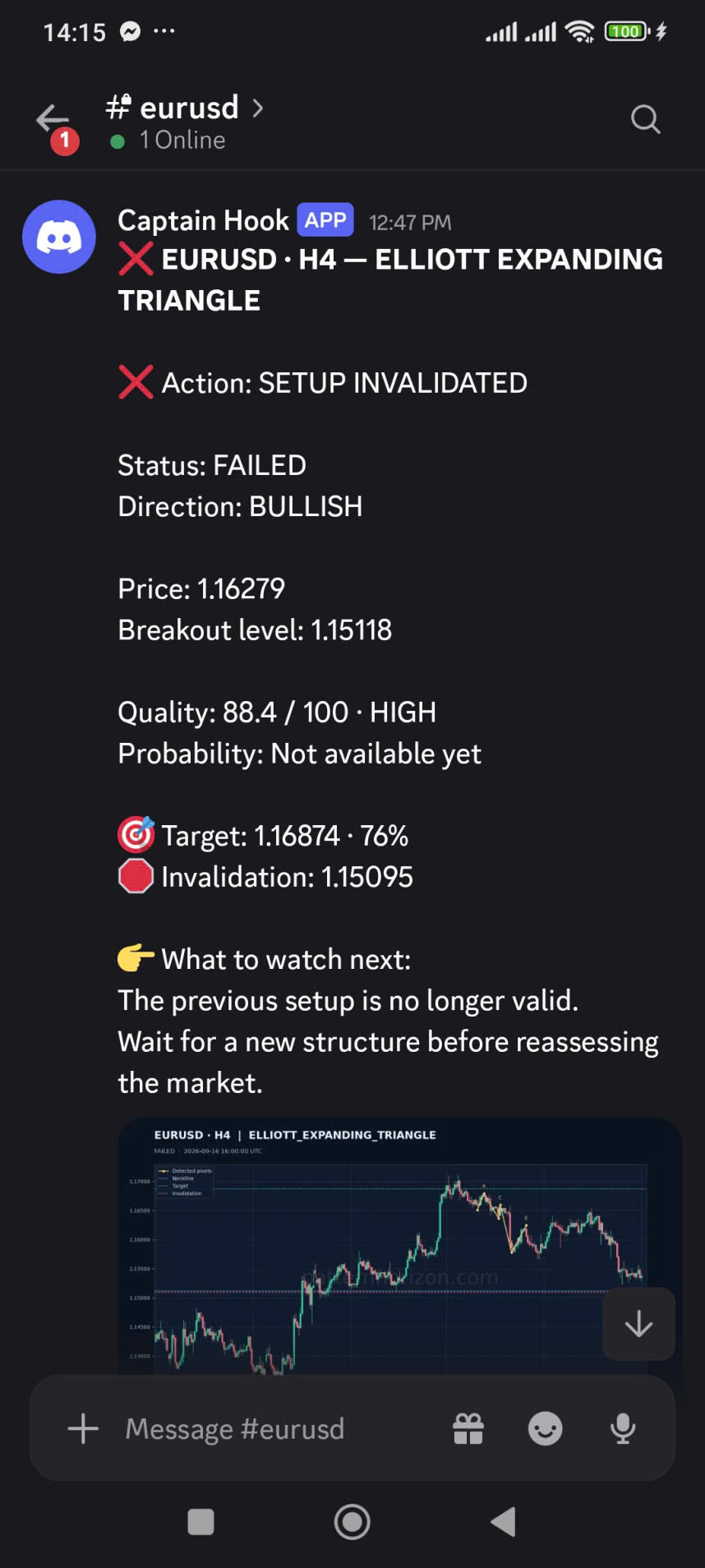
The illustrated message shows a HIGH-quality Elliott setup whose lifecycle later became FAILED with Action: SETUP INVALIDATED. Quality described the structure; Invalidation defined the boundary; FAILED recorded the later outcome. Each field performed a different job.
The guidance is direct: the previous setup is no longer valid, so wait for a new structure before reassessing the market. Keeping the failed event visible prevents hindsight bias and lets users review both favorable and unfavorable outcomes.
Do not continue using the old Target after invalidation as though the lifecycle had not changed. Also do not treat the failure as an automatic signal in the opposite direction. Close the old hypothesis and require new evidence for the next one.
Read the lifecycle guideA practical reading sequence
This sequence keeps analytical boundaries separate from personal execution decisions.
Levels belong to one detected structure and should not be transferred to another symbol, timeframe, or later setup.
Determine whether the signal is awaiting confirmation, confirmed, completed, failed, or otherwise unresolved.
Identify the boundary that advances the setup and avoid assuming it has been satisfied before the system records confirmation.
Treat the value as the primary tracked objective and any attached percentage as target probability—not progress or return.
Understand where the current hypothesis ends without automatically turning that value into a universal stop-loss.
Check Direction, Alignment, Quality, probability availability, zones, and the most recent lifecycle event.
Verify current prices and account for execution, volatility, liquidity, spread, slippage, leverage, and possible loss.
Common mistakes
Avoid reading Breakout level as an exact entry order, Target as guaranteed take-profit, and Invalidation as a personalized stop-loss. The message describes a structured market hypothesis; it does not know an individual's execution or suitability.
Do not interpret the Target percentage as progress or expected account return. Do not retain an old target after FAILED or INVALIDATED. Do not chase a target after TARGET_REACHED. Do not move a level from H1 to H4 or combine boundaries from unrelated signals.
Finally, do not judge a setup only by the apparent distance between Target and Invalidation. Current price, confirmation state, volatility, spreads, gaps, liquidity, and feasible execution matter. A visually attractive ratio cannot remove market risk or make an unconfirmed pattern confirmed.
Keep each boundary in its role
Open a current signal and compare its key levels with the latest lifecycle update before forming an independent view.
View signalsImportant information
Pattern Horizon provides market information and educational content only. Breakout levels, targets, target probabilities, invalidation levels, statuses, directions, and scores are not personalized investment advice, order instructions, or guarantees of profit. Patterns can fail, prices can gap or move rapidly, and actual execution can differ from displayed references.
Independently verify current prices and conditions, understand the instrument, and decide whether any setup fits your own method and circumstances. Account for liquidity, volatility, spread, slippage, leverage, and possible loss, and seek qualified professional advice where appropriate.