
1. Start with symbol and timeframe
Confirm that the market and analytical horizon match what you intend to review. A setup on one timeframe should not be assumed to describe every other timeframe.
Article
Pattern Horizon turns detected market patterns into structured, real-time signal context—helping traders review symbols, timeframes, price zones, states, and setup changes without automating their decisions.
Pattern Horizon explained
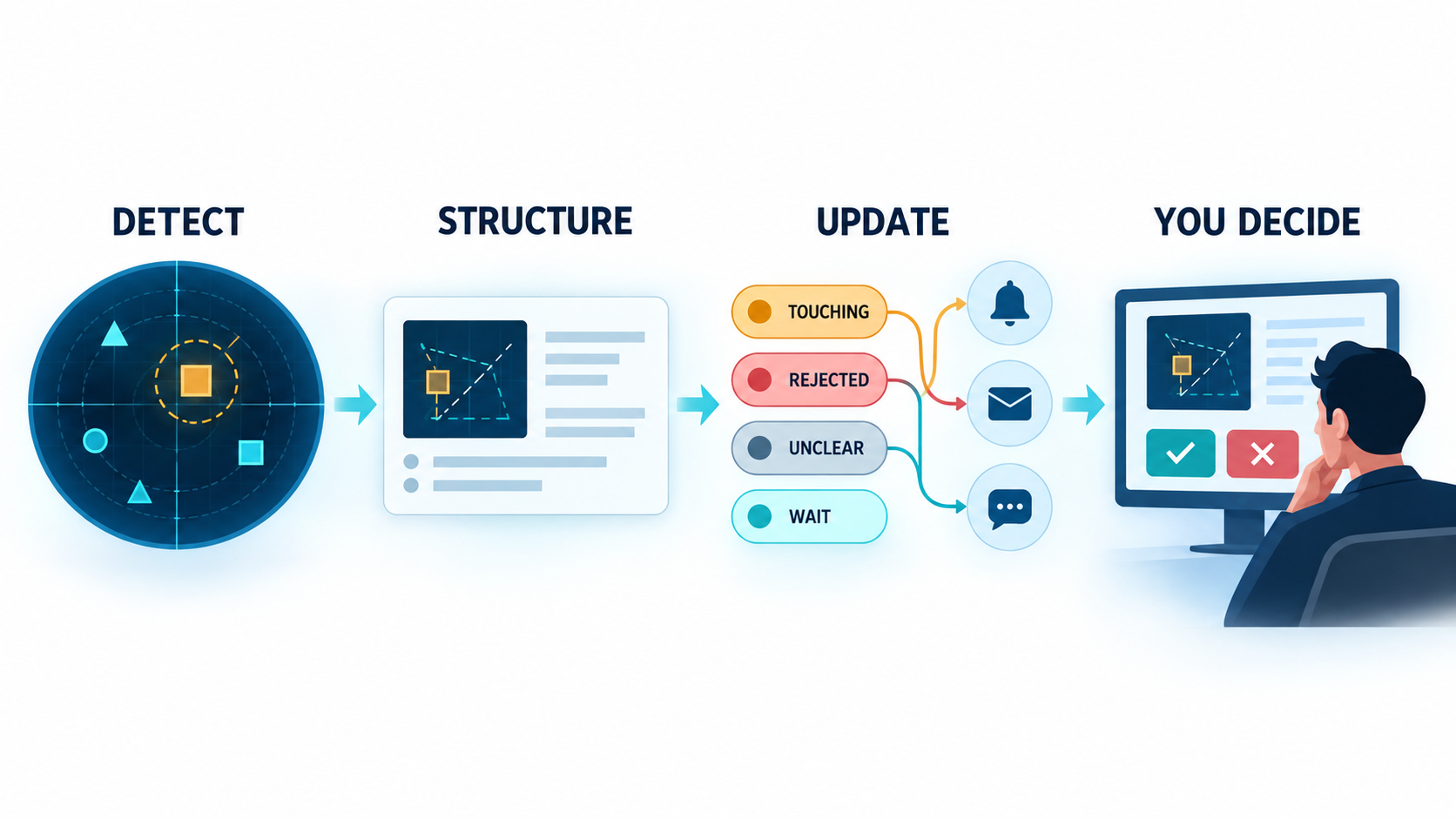
Many traders receive dozens of alerts a day: “Buy XAUUSD,” “Sell EURUSD,” or “breakout detected.” The message may arrive quickly, but the work has only begun. Which timeframe produced it? Is price approaching a zone or already reacting there? What structure supports the idea, and what would invalidate it? Pattern Horizon takes the opposite approach: it detects market patterns and organizes each setup as structured, evolving information rather than presenting a context-free command.

The alert problem
A short directional alert can be convenient, but it often leaves the recipient rebuilding the analysis from scratch. The trader must identify the symbol, open the correct timeframe, locate the relevant price zone, compare nearby support and resistance, and decide whether the setup is early, active, or already invalid. When many alerts arrive together, that reconstruction becomes repetitive and easy to misread.
Pattern Horizon is designed to reduce that fragmentation. It treats a detection as the beginning of a documented setup. Related fields remain attached to the signal, while later state changes form a readable history. The goal is not to remove analysis; it is to give analysis a consistent starting point so traders can spend less time assembling scattered details and more time evaluating what those details mean.

Pattern detection
The platform processes supported markets for structured detections such as swing highs and lows, support and resistance zones, cup-and-handle formations, and Elliott Wave structures. These pattern families describe different aspects of market behavior. A swing point can help define local structure; support or resistance can identify an area where reactions matter; a cup-and-handle can describe a longer formation; and an Elliott Wave interpretation can express a developing sequence.
A detection is not treated as proof that price must move in a particular direction. Patterns can overlap, fail, or remain ambiguous. Their practical value comes from recording what was detected, where it occurred, and how the evidence changes. By normalizing those observations, Pattern Horizon makes unlike setups easier to scan and compare without pretending that every pattern has equal importance or certainty.
Explore signalsSignal anatomy
A Pattern Horizon signal is more than a buy-or-sell label. It can carry the symbol, timeframe, expected direction, current state, pattern-quality assessment, relevant levels, and the lifecycle of the setup. Together, those fields answer basic review questions: What market is this? At what analytical scale? Is the setup bullish, bearish, or still unclear? Is price far from the zone, approaching it, touching it, awaiting confirmation, or reacting away from it?
The quality field helps summarize the strength or completeness of the detected structure under the system’s criteria. It should not be read as a win rate, probability of profit, or promise that a target will be reached. Direction is also descriptive, not an order. When the available evidence conflicts, an UNCLEAR reading may be more honest than forcing a bullish or bearish conclusion. Structure improves transparency, but the user must still interpret the information in context.
Changing conditions
Market setups change as price moves. A signal may begin while price is far from an area, progress through FORMING or APPROACHING, and later become TOUCHING when the relevant zone is reached. It may then wait for confirmation, become CONFIRMED, show REJECTED behavior, break through a level, expire, or be invalidated. Not every setup follows the same path, and a later event can materially change the original interpretation.
This is why Pattern Horizon keeps state and event history instead of freezing the first message. TOUCHING means the market is interacting with an area; it does not mean the reaction has succeeded. REJECTED records a reaction away from a level, but does not guarantee continuation. WAIT can be the appropriate reading when confirmation is missing. A possible breakout should be evaluated only after the conditions that define it become observable. The lifecycle turns a one-time alert into a sequence the user can review.
Real-time delivery
When the system records a meaningful state change, the website can receive the update through its real-time stream. Eligible users can also configure optional delivery to Telegram or Discord for selected symbols. These channels are notification paths: they do not place, manage, or close trades. The website remains the place to review the structured setup and its event history.
“Real time” means updates are distributed after the platform processes and records them; it does not mean zero latency. Market feeds, detection schedules, networks, browsers, and third-party messaging services can all introduce delay. A notification should therefore be treated as a prompt to review current information—not as an instruction that can be followed without checking price, timing, liquidity, or personal risk constraints.
Explore signalsA practical workflow
A consistent review process helps turn structured data into a disciplined decision. These five steps are a starting framework, not a trading recommendation.
Confirm that the market and analytical horizon match what you intend to review. A setup on one timeframe should not be assumed to describe every other timeframe.
Understand what was detected and where the relevant support, resistance, swing, or formation boundary sits relative to current price.
Treat direction as an interpretation and quality as a structural assessment. Check whether nearby evidence agrees or produces an UNCLEAR result.
Distinguish APPROACHING from TOUCHING, and interaction from confirmation. If the state says WAIT, avoid inventing certainty that the data does not yet show.
Check what changed since detection, verify current market conditions, and independently decide whether the setup fits your method, limits, and tolerance for loss.
Access and language
Pattern Horizon uses plan-based entitlements so access to symbols and delivery options follows the user’s subscription. The Free plan provides a limited starting universe, while paid tiers expand the number of symbols that can be selected; the current Plans page is the source for commercial details. The interface and CMS content support English, Vietnamese, Simplified Chinese, Spanish, Brazilian Portuguese, and Japanese. Localization makes the platform easier to read, but core state labels may remain visible in English where consistency across notifications and event histories matters.
Purpose and limits
Pattern Horizon is intended to shorten the time required to find and organize market setups. It does not connect the lifecycle to automatic trade execution, copy another trader, or decide position size on a user’s behalf. A well-structured signal can clarify what the system sees, but it cannot know an individual’s financial situation, objectives, experience, tax position, or tolerance for volatility.
Use signals as market information and educational information. Compare them with current prices and your own analysis, account for spreads and execution conditions, and define risk before acting. No pattern, state, quality assessment, or notification guarantees profit or prevents loss. The trader remains responsible for every decision—the final and most important step in the Pattern Horizon workflow.
See the pattern before the horizon shifts
Review available signals, follow their state changes, and choose a plan that matches the symbols you want to monitor.
View plansImportant information
Pattern Horizon provides market information and educational content only. It is not personalized investment, financial, legal, or tax advice, and it does not guarantee results. Trading and investing involve risk, including the possible loss of capital. Independently assess each decision and seek qualified professional advice where appropriate.